

Being a pharmacist is about precision, speed, and safety every day. Still, many stores cannot cope with full aisles, misplaced goods, and storage systems that slow down the workflow.
Such problems not only frustrate the employees but also impact the client’s trust and operational efficiency. Even simple tasks become complicated when there are no shelves to support the pace of service.
As inventory grows and patient expectations rise, unstructured storage systems become a persistent storage setback. An adequately designed shelving system can solve these problems.
It brings about order, increased visibility, and benefits the regular running of daily activities. This article examines the key attributes any pharmacy should consider when updating or assessing its product storage systems.
1. Adjustable Design for Flexible Inventory Management
The modularity of modern pharmacy shelving is an important aspect, as product sizes may vary and stock needs may change. The movable shelves also allow personnel to adjust layouts in real time to accommodate seasonal, new product, or patient needs.
This ensures the day-to-day items are always at hand; the stock that is not required urgently is well kept in the other parts. Moreover, the mobile shelves minimize clutter by limiting the need for temporary storage.
The inventory can also be reorganized quickly without affecting the work process, thereby expanding. This flexibility ultimately reduces downtime and increases accuracy at the dispensing point.
The short, structured segments also come in handy for adequate product differentiation. This implies that pharmacists do not spend much time searching for items and have time to attend to customers.
2. Durable Materials for Long-term Stability

Another required feature is durability, as the conditions in a pharmacy require constant movement and re-handling. Shelves that may support heavy weights and resist degradation should be made of high-grade steel or reinforced alloys.
This guarantees a long-term performance without regular replacements. In addition, the integrity of sensitive pharmaceutical products is ensured by durable materials.
Good shelves would stand firm even with full stocks, thereby reducing the risk of spillages and damaged packaging. Additionally, long-term construction minimizes maintenance time.
The employees can also be assured of the shelves’ efficiency and reliability. This later translates into a less costly operation and a healthier environment for employees and customers.
3. Modular Configurations for Optimized Space Usage
Pharmacies are usually located in small areas, which makes modular shelving vital. A modular system allows sections to be added, removed, or moved around according to the workflow requirements. This ensures that every square foot is used efficiently.
Scalability in the future is also encouraged in modular arrangements. With the addition of new services, e.g., a vaccination area or an expanded OTC area, the shelving layout may change. Such flexibility enables unceasing expansion without costly redesigns.
Moreover, modular systems help simplify traffic by grouping medications and supplies into separate areas. Having well-defined sections makes it easier for employees to move around the store, improve their stock view, and minimize congestion behind the counter. This increases precision and efficiency in the day-to-day running.
4. High Visibility Designs for Faster Retrieval
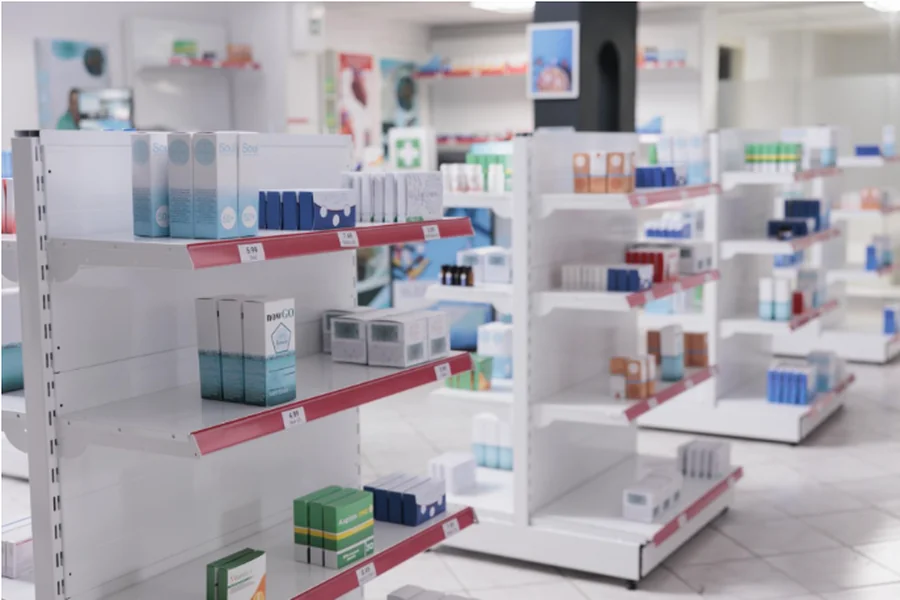
Visibility is an essential element of pharmacy efficiency. Open-front shelving and well-spaced line-of-sight shelving enable one to locate a product immediately. The high-visibility shelving minimizes the time required to obtain a specific type of medication, particularly during peak hours.
In addition, improved visibility reduces the risk of dispensing errors. When packaging and labels are easy to read, staff can get the right product without any doubt. Organization is also clear, helping new employees adapt quickly and minimizing training time.
The other benefit is improved stock turnover. High-visibility designs help staff spot near-expiry dates faster and rotate inventory effectively. This aids in the reduction of unnecessary wastage and also the provision of the most suitable products to the patients at all times.
5. Integrated Safety Features for Compliance
A pharmacy is a place where safety is non-negotiable, which is why built-in safety functionality is a necessity. Locking compartments on shelves are used to secure controlled substances and to minimize unauthorized access.
These built-in protections align storage practices with regulatory requirements. Also, rounded edges and stable frames make the workplaces safer. Technicians are very fast-paced in dispensing, thus shelves should be secure and not sharp.
Accidents and injuries are curtailed when safety features are incorporated in the design. It is also significant that shelving units are properly ventilated. It helps preserve product integrity and prevent moisture formation.
Pharmacies with compliant, purpose-built shelves achieve a higher standard of care, along with supportive, consistent, and safe operations.
6. Ergonomic Designs for Improved Workflow
Ergonomic shelf designs reduce physical load and facilitate a more productive work rhythm. Shelves positioned at an optimal height minimize bending and reaching, allowing staff to move fluidly throughout their tasks.
This, in the long run, helps achieve high productivity and employee comfort. Furthermore, the ergonomic plans place essential items within arm’s reach. Fast-moving goods, such as prescriptions, OTC drugs, or commonly used packages, remain accessible at all times. This minimizes unnecessary movement and maximizes dispensing speed.
Ergonomic setups also facilitate a clean visual arrangement. If the shelves are arranged according to the natural workflow, the restocking process becomes intuitive. The employees can maintain order more easily, which helps contribute to higher-quality service overall.
Final Thoughts
Efficient shelving is not just a storage tool; it is an integral component of pharmacy operations. Adaptable design, durable construction, modular building, increased visibility, built-in protection, and ergonomic design all help create a streamlined and reliable working environment.
When these features are combined, pharmacies experience increased workflow, higher compliance, and enhanced patient care. Investing in the right shelving design ultimately improves the performance, safety, and long-term success of any pharmacy.